
Knee replacement,
priced honestly
The most common joint replacement in the world, and the one with the widest spread between what a hospital bills, what a cash-pay center charges, and what it costs in Medellin. Here is all of it.
Knee replacement pricing, by procedure type
Midpoints of typical ranges. These are research figures compiled from public sources, not quotes. Your price depends on implant selection, surgical complexity, hospital, and length of stay.
If a surgeon has told you that you are bone on bone and it is time to replace the joint, the medical decision is usually the easy part. The hard part is what happens when the billing office gives you a number, or when your insurer denies the pre-authorization, or when you find out the earliest surgical date is in March.
This page is the cost picture, start to finish. It is not medical advice and it is not a quote. It is what the research says a knee replacement costs in each of the places you might have one.
What you are actually buying
A total knee replacement resurfaces three compartments of the joint. The surgeon removes the damaged cartilage and a thin layer of bone from the end of the femur and the top of the tibia, then caps both with metal components separated by a polyethylene spacer that acts as the new bearing surface. The kneecap may or may not be resurfaced depending on its condition and the surgeon's preference.
A partial knee replacement, sometimes called a unicompartmental knee arthroplasty or UKA, only resurfaces the damaged compartment and leaves the rest of your native knee intact. It is a smaller operation with a faster recovery, and roughly a quarter of knee arthritis patients are candidates. Whether you are one of them is determined by which compartments are worn, the state of your ligaments, and your alignment — which is exactly why imaging has to come before any price conversation.
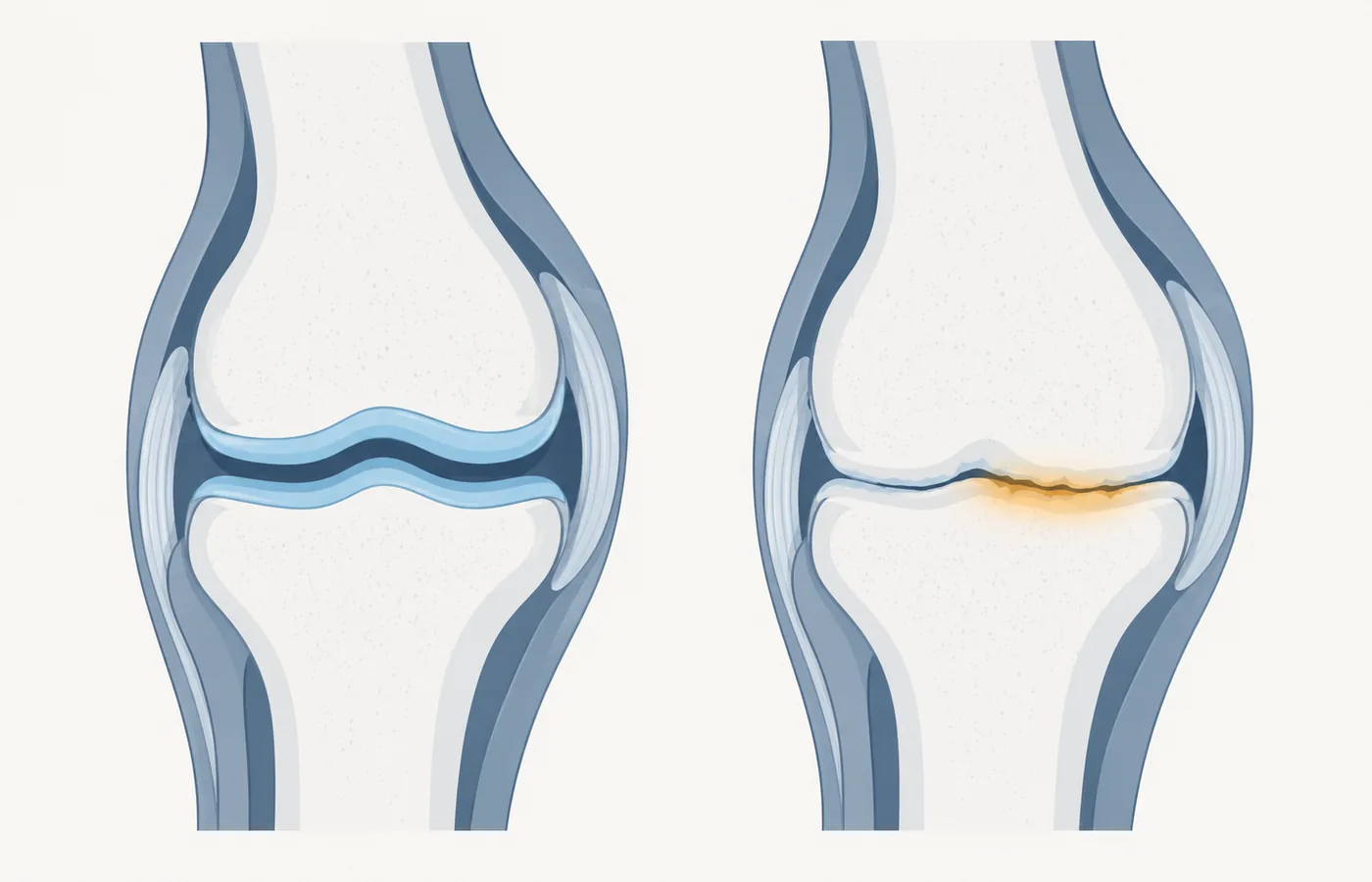
Left: healthy cartilage cushion between femur and tibia. Right: worn cartilage with bone-on-bone contact and inflammation.
The three prices
There is no such thing as "the" price of a knee replacement in the United States. There are at least three, and which one you see depends entirely on how you enter the system.
| Setting | Typical all-in | What is included |
|---|---|---|
| US hospital, commercial billed | $35,000–$50,000 | Highly variable. Facility fee, surgeon, anesthesia, implant, and stay are often billed separately, and the sticker figure is a negotiating position rather than a price. |
| US transparent cash-pay center | $17,679 | The published all-inclusive bundle at Surgery Center of Oklahoma, covering surgery, implant, five days of home health, thirty days of physical therapy, durable medical equipment, and medications. |
| US marketplace (MDsave and similar) | $16,600–$23,700 | Prepaid bundles at participating facilities. Availability depends heavily on your region. |
| Colombia, private | $8,000–$13,000 save 65–80% | Typically surgeon, anesthesia, implant, operating room, and two to four hospital nights. Travel, lodging, and home rehab are separate. |
Check the domestic option first. If you live within driving distance of a transparent-pricing surgical center, the gap between $17,679 at home and roughly $10,500 plus travel abroad is real but not enormous. Medical travel makes the most sense when your local option is a $40,000 hospital bill or a nine-month wait after an appeal. Run both numbers before you buy a plane ticket.
What moves the Colombia number
- Implant selection. A standard cobalt-chrome and polyethylene implant sits at the bottom of the range. Highly cross-linked polyethylene, oxidized zirconium femoral components, or a patient-specific cutting guide move it up. Ask for the manufacturer and model in writing — the major implant makers sell the same products worldwide.
- Robotic assistance. Available at several Colombian centers and typically adds to the price. The evidence on whether it improves long-term outcomes over a well-executed conventional technique is still being argued in the literature. It is not a reason to pick a surgeon by itself.
- Complexity. Significant deformity, prior hardware, obesity, or a revision all raise the price and the risk. Revisions in particular deserve serious thought about whether to have them close to home.
- Hospital tier. A JCI-accredited facility with a dedicated international patient department costs more than a smaller private clinic. You are partly paying for the infrastructure that exists when something goes sideways at two in the morning.
- Length of stay. Most quotes assume a specific number of nights. Ask what an additional night costs before you need one.
Recovery, without the marketing gloss
The operation is a small fraction of the outcome. What determines whether you are happy in a year is the twelve weeks of rehabilitation afterward, and that work is the same in Medellin as it is in Michigan.
| Phase | Timeline | What it looks like |
|---|---|---|
| Hospital | Day 0–3 | Standing and taking assisted steps within roughly 24 hours at most centers. Pain management, clot prophylaxis, and early range-of-motion work. |
| Early recovery | Week 1–2 | Walker or crutches. Daily physical therapy. This is the hardest stretch and the reason you want ground-floor lodging. |
| Cleared to fly | Day 10–14 | Typical surgeon guidance, driven mostly by clot risk. Confirm with yours; do not assume. |
| Functional | Week 6–12 | Walking unaided, driving again, most daily activity restored. Continued therapy at home. |
| Full recovery | Month 3–12 | Swelling continues resolving for months. Final result is often not apparent until close to a year. |
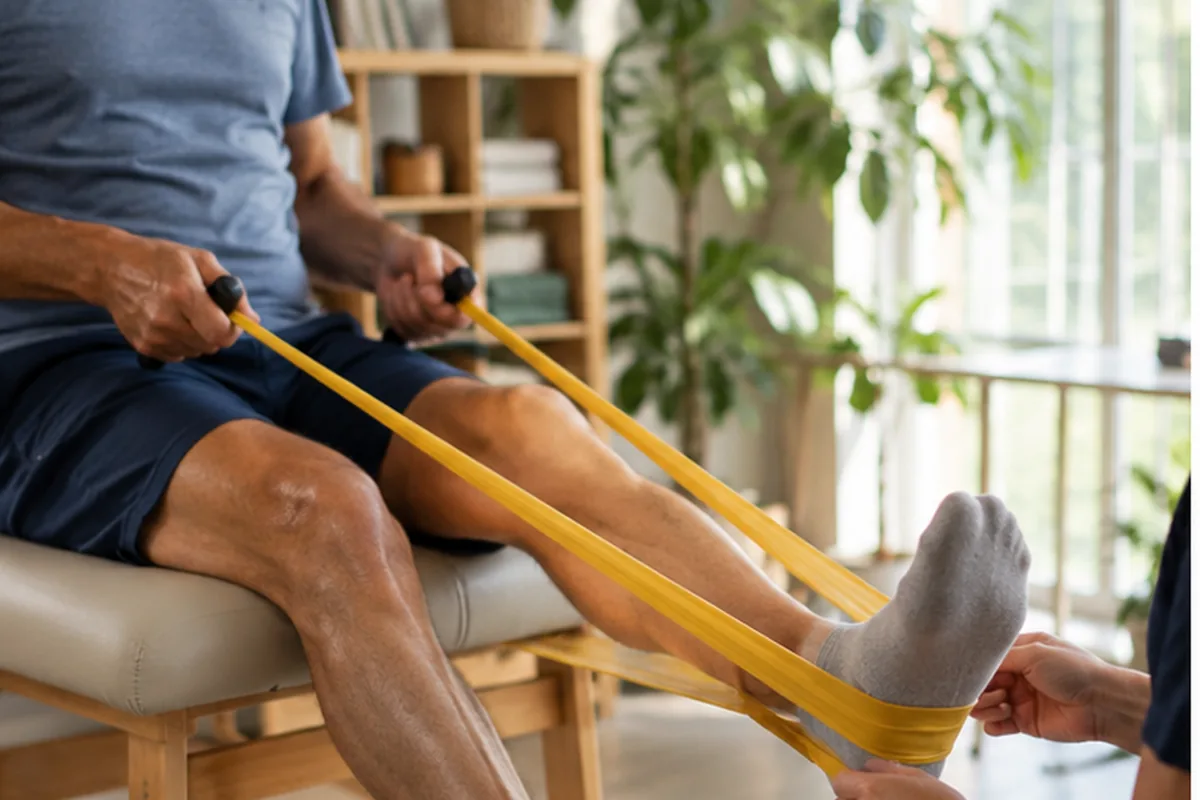
The twelve weeks after surgery matter more than the two hours during it. Budget for therapy at home.
How to vet a surgeon from four thousand miles away
Two checks do most of the work, and both are free.
- ReTHUS. Every physician licensed to practice in Colombia appears in the Registro Único Nacional del Talento Humano en Salud. Search the surgeon's full name and confirm the specialty registration. If they are not in there, the conversation is over.
- JCI directory. Hospital accreditation is verifiable in the Joint Commission International accredited organizations list. Note that accreditation applies to the hospital, never to an individual surgeon or a standalone clinic — if someone describes themselves as "JCI-certified" personally, that is a misuse of the term and a signal about how carefully they handle other claims.
Beyond the paperwork: ask how many total knees the surgeon performs a year, ask what their revision rate is, ask what happens if you develop an infection after you fly home, and ask for the implant model in writing. A good surgeon answers all four without getting defensive.
For the wider safety picture on Colombian hospitals, accreditation, and city-level considerations, see SafeMedicalTravel.co. For the full Colombia medical travel hub, see ColombiaMedical.co.
Who should not do this
An honest cost guide has to include the cases where the answer is no.
- If you have significant cardiac, pulmonary, or clotting risk factors, the flight is a real hazard and a local surgery is safer even at four times the price.
- If you are facing a complex revision with prior hardware, having it done where your follow-up care lives is usually worth the money.
- If you have no support person who can travel with you, reconsider. Week one is genuinely difficult alone.
- If your local option is a transparent cash-pay bundle within driving distance, the savings may not justify the logistics.
Questions people ask about this one
Is a partial knee replacement cheaper than a total?
Usually yes — typical Colombia ranges for a partial run roughly $6,500 to $10,000 against $8,000 to $13,000 for a total, and recovery is generally faster. But candidacy is a clinical question, not a budget one. Only about a quarter of arthritis patients have the isolated single-compartment wear and intact ligaments that make a partial appropriate.
Can I have both knees done on the same trip?
Bilateral knee replacement is offered and it does reduce the total cost against two separate trips, with typical Colombia ranges around $15,000 to $20,000. It is also a substantially bigger physiological event with higher complication rates, and it requires a longer stay and much more support during recovery. Many surgeons will decline it for patients over a certain age or with cardiac risk. Treat a fast yes to this question as a warning sign.
What implant brands are used in Colombia?
The same major international manufacturers that supply US hospitals distribute in Colombia. What matters is getting the specific manufacturer and model written into your quote rather than a generic description, so you can research it and so there is no substitution later.
How much should I budget beyond the surgery itself?
Plan on roughly $3,000 to $5,000 on top of the surgical bundle for a two to three week trip: round-trip flights, accommodation suitable for someone on crutches, ground transport, meals, a companion's costs, and travel insurance. Then budget separately for physical therapy once you are home, since that is usually the largest ongoing expense and it is rarely included in any package.
What if I need a revision later?
Modern knee implants commonly last fifteen to twenty years or more, but revisions do happen. Ask before you travel who would handle it and what documentation you will receive — you want the operative report, the implant stickers or lot numbers, and post-op imaging, all in a format a US surgeon can work from. Bring copies home in more than one place.
Get a real number for your joint.
Tell us the joint, the side, and your timeline. We come back with typical 2026 ranges from Medellin and Bogota — not a sales pitch, and not a quote until a surgeon has seen your imaging.
One vertical of a larger research project
Joint Replacements is the orthopedic arm of a Colombia-focused medical travel network. Same standards, same person behind it, different procedure.